Something is happening in the gothic romance corner of the internet, and I don't think the mainstream has noticed yet. Over the last year or two, I've seen an uptick in serialized stories that draw directly from the gothic tradition — Rebecca, Jane Eyre, Wuthering Heights, The Turn of the Screw — and do something new with them.
That lineage matters, because gothic romance is not a mood you can paste onto any story. It is a structure, and the stories in this revival understand that structure in a way that a lot of recent romance, with its emphasis on speed and clarity, has forgotten. The revival is quiet precisely because it is slow. It does not announce itself with a trend or a hashtag. It accumulates, chapter by chapter, in the corners of the internet where readers still have patience for atmosphere.
The tropes that keep resurfacing
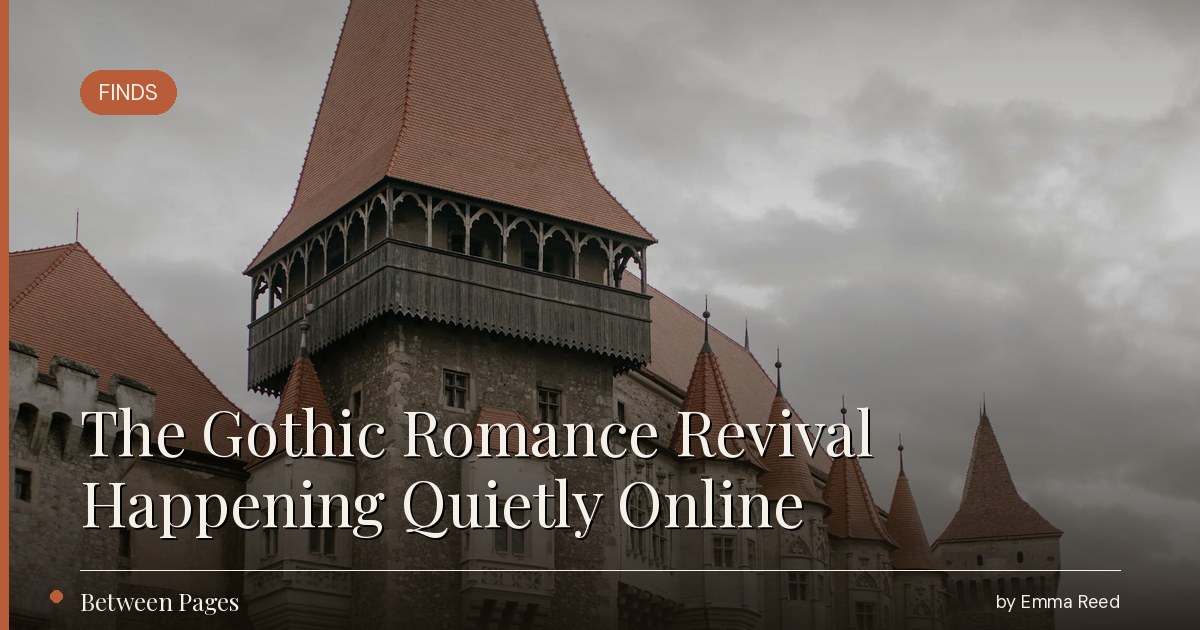
The gothic romance revival is using the old furniture. A large, old house with a complicated history. A hero whose past the heroine can't quite piece together. A first wife — living, dead, or metaphorical. Weather that seems to participate in the plot. A sense that the building itself has opinions.
These are ancient conventions, and they still work. There's a reason readers have kept returning to this shape for two hundred years. The gothic romance is a container for a specific kind of anxiety — about marriage, about trust, about the past you can't access — that hasn't gone away.
What interests me is how little those anxieties have changed, even as the settings have. A heroine entering a household where someone else's history already fills every room is not a period problem. It is the problem of any relationship in which one person arrives late to a life already fully formed. The house is a way of making that problem visible. You can walk through it, hear it creak, find a locked door. The metaphor does not need explaining, because the building explains it.
Where the new gothic lives
Most of what I've been reading is serialized and online. Traditional romance publishing has a hard time with gothic — it's too slow, too atmospheric, the conflict too interior. But serialized fiction is perfect for it. Gothic romance is built on dread, and dread is what chapter-by-chapter pacing does best.
Serialization gives dread a schedule. A chapter can end on a half-heard conversation, a portrait that looks different in new light, a question the heroine is afraid to ask — and then the reader has to live with that question for days. In a finished novel, you turn the page. In a serial, you wait, and waiting is the gothic emotion. The form does not merely carry the story; it enacts it.
If you want to understand why the template keeps working, the clearest education is still going back to Daphne du Maurier — Rebecca especially, but also My Cousin Rachel and Jamaica Inn. Every gothic revival story I've read lately is in conversation with her, whether the authors realize it or not. The second wife haunted by the first, the house that knows things, the narrator you slowly stop trusting — she didn't invent any of it, but she perfected it.
Gothic romance isn't about the haunted house. It's about the heroine slowly realizing the house is the least haunted thing in the story.
That line has stayed with me because it reframes the whole genre. The haunting is rarely supernatural, even when a story flirts with the supernatural. The haunting is a marriage, a family, a reputation, a past that will not stay past. The house is just where all of that lives, conveniently, under one roof.
What the revival gets right
The gothic stories that are actually working understand that gothic isn't a setting — it's a stance. You can write gothic romance in a modern apartment. You can write it on a spaceship. What matters is the atmosphere of partial knowledge — the heroine piecing together a story someone else has been living longer than she has.
The ones that don't work are the ones that borrow the aesthetic — the fog, the black silk, the gloomy manor — without borrowing the structure. A gothic romance without the slow accumulation of wrongness isn't gothic. It's just costume.
I have learned to test a new gothic serial by its second or third chapter, not its first. The first chapter can always deliver fog and a handsome, withholding hero. The test is whether the second chapter adds a small, specific wrongness: a detail that does not fit, a kindness that arrives a beat too late, a story told twice with one fact changed. If the wrongness accumulates, the writer understands the form. If the story merely repeats its opening atmosphere, it will run out of weather long before it runs out of chapters.
That accumulation also explains why the revival suits online reading so well. A reader following a serial is already in a state of partial knowledge — waiting for the next chapter, rereading the last one, theorizing in the comments. The gothic heroine's position and the serial reader's position are the same: both are trying to assemble a story from incomplete evidence. Good gothic writing exploits that parallel, whether deliberately or not.
Why now
I don't know exactly why this revival is happening. But I notice it's happening at a moment when a lot of contemporary romance feels increasingly fast, increasingly plot-mechanical, increasingly frictionless. Gothic romance is the opposite of frictionless. You feel every page. You wait for things. You distrust the narrator, and sometimes you should.
There is also a quieter reason, I think. Gothic romance takes the interior life seriously in a way that plot-driven romance often does not. The heroine's uncertainty is not a delay before the real story; it is the real story. Her misreadings, her second thoughts, her slow revision of what she thought she knew — those are the plot. For readers tired of stories that explain themselves in chapter one, that interiority is a relief.
If you're tired of romance that tells you everything in chapter one, the gothic revival is where you go. It still believes in withholding. Start with the classics it draws on, if you have not read them recently, and then follow the serials that are doing the same work in new settings. Read slowly. Let the wrongness accumulate, chapter by chapter, and resist the urge to rush toward an explanation. The explanation, when it comes, will mean more for having been waited for. That is the whole pleasure, and it is one the mainstream has largely stopped offering.